RDS Dekoder
Computer im Selbstbau
Ich habe mir schonmal ein Computersystemen selberentworfen. Zur Zeit der Entwicklung des unten beschriebenen Boards fand ich die "alten" 8 Bit Systeme sehr reizvoll, speziell die sehr einfach zu programmierende 6502 CPU. Der Hintergedanke ist einen einfachen Computer zu haben der Hardwaresteueraufgaben übernimmt und über eine Standardschnittstelle (z.Zt. serielle Schnittstelle) mit einem Linux Rechner Kontakt aufnimmt. Stürzt der Rechner wegen Programmierfehlern oder H/W Problemen ab, so ist er innerhalb weniger Sekunden wieder online, da die ganze Software im ROM gespeichert ist. Heute könnte man auf einer solchen Platine ein komplettes 32 Bit System mit genügender Rechenpower für ein Linuxsystem unterbringen.
Update (Aug. 2005): An der Universität bin ich dabei an einem 32 Bit Computersystem mit ARM CPU zu arbeiten und diese dann direkt unter Linux laufen zu lassen. Eine erste Übersicht über das Projekt habe ich schon erstellt.
Update (2016): Mittlerweile ist der Eigenentwurf von kleinen Embeddedsystemen nicht mehr nötig. Der Markt ist voll von Raspberry PI und ähnlichen Einplatinensystemen die Linux oder sogar Windows laufen lassen können. Darüber hinaus gibt es die Arduino Welt für kleine Aufgaben. Alles äußerst Stromsparend. Deshalb ist auch dieses Projekt im historischen Kontext zu sehen (Der Entwurf und Aufbau ist schon fast 25 Jahre her)..
RDS Dekoder
Als interessante Applikation habe ich schon 1994 einen RDS Dekoder entworfen und auch umgesetzt inklusive Betriebssystem zur Verarbeitung der Daten, Tastatursteuerung, LC-Display Ansteuerung (okay, eines dieser 2*16 Zeichen Fertigmodule, aber der Anschluß an den Prozessorbus ist eine Idee von mir die nur einen 74LS245 benötigt). Kurz und gut, eine schöne Herausforderung.
Beschreibung
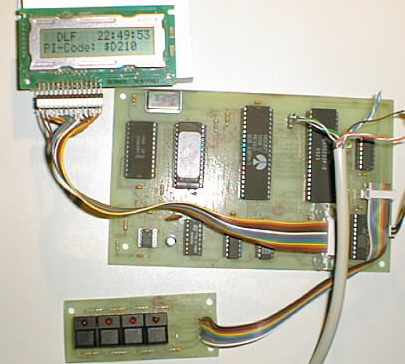
Rechts sieht man verkleinert die fertige RDS Dekoderplatine komplett aufgebaut mit dem Display und der Tastatur. Im Moment der Aufnahme war Bayern3 eingestellt.
Wie man auch sehen kann, besteht der Computer im wesentlichen aus einem 65C02, eine 8 KByte EPROM, einem 2K RAM Baustein und einem 65C22 I/O Port, der die RDS Daten empfängt, die LEDs ansteuert und die Tastatur unter Kontrolle hat. Das hier im Bild sichtbare, zweckentfremdete CAT-5 Kabel liefert die RDS Daten schon in digitaler Form von einer IC-Dekoderschaltung.
Ein nettes Feature der Software ist die automagische Berechnung von Datum und Uhrzeit anhand der mitgelieferten RDS Daten. Die Uhrzeit wird in meiner Software immer oben rechts angezeigt, der 8 stellige Stationsname immer links. So sind die 16 Zeichen der 1. Zeile des LC-Displays voll genutzt.
In der zweiten Zeile werden die vom Benutzer gewünschten Informationen angezeigt. Im Bild sieht man eine Stück vom Radiotext von Bayern3. Da die Software selbergeschrieben ist kann man sich auch "Gimmicks" wie z.B. den Programm-Identifikationscode angucken. Zur Auswahl stehen: Radiotext, Datum, Alternativfrequenzen, PI-Code, Programmtyp, Verkehrsfunkkennung, Musik/Sprache Flag.
Schaltplan und Betriebssystem
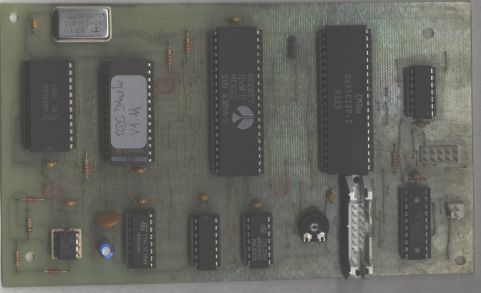
Für Interessierte gibts die Software zu diesem ersten Rechner natürlich auch zum herunterladen. Die Software unterliegt der GPL, wer also den Code als Basis für einen eigenen Dekoder oder einfach nur zum Ideen sammeln verwenden möchte darf dies gerne tun. Zusammen mit dem Schaltplan kann man sich sogar dieses Gerät nachbauen.Eine noch größere Detailansicht gibt es natürlich auch.
Assembliert werden kann das ganze übrigens mit dem Assembler dasm unter Linux. Informationen und download von dasm auf www.ibiblio.org.
Bilder
Bild des RDS Dekoders "in Action"
![[ Bild: Hauptansicht des
RDS-Dekoders. Download zur Ansicht empfohlen ]](pictures/RDS-Dekoder-in-Action.jpg)
Anwahl des Bildes führt zu einer doppelt so großen Darstellung.